

Sculptor Nnena Kalu has made history as the first learning-disabled artist to win the Turner Prize, one of the most recognisable awards in contemporary art. Her win, announced in Bradford on 9 December 2025, is being celebrated across the UK – but it also has a meaningful local connection here in West Yorkshire through the work of Purple Patch Arts and Pyramid, two organisations that champion creativity, inclusion and learning-disabled artists.
The news has been covered across mainstream media including BBC News, Sky News and Bradford 2025.
A landmark win for contemporary art
Born in Glasgow in 1966 to Nigerian parents and now based in London, Kalu has spent more than 25 years developing her practice with ActionSpace, an organisation that supports learning-disabled artists. Her recognition by the Turner Prize jury has been widely described as a breakthrough moment, “smashing a very stubborn glass ceiling”, as her Artistic Director Charlotte Hollinshead told the crowd in Bradford.
The jury praised her work as “bold and captivating”, highlighting her distinctive hanging sculptures and swirling abstract drawings. Much of her art is built through repeated, physical movements – wrapping, binding and layering materials such as VHS tape, rope, fabric and paper into cocoon-like forms. Critics often describe the work as rhythmic and hypnotic, shaped as much by sound and movement as by colour and texture.
Kalu was shortlisted for her exhibition Conversations at the Walker Art Gallery in Liverpool and for Hanging Sculpture 1–10, a series commissioned for Manifesta 15 in Barcelona, where enormous, brightly coloured installations hung from industrial concrete pillars.
Her Turner Prize win is not symbolic; it is entirely merit-based, as jury chair Alex Farquharson emphasised. But its significance is undeniable. This is the first time the prize has been awarded to a learning-disabled artist, marking an overdue shift in visibility and recognition.
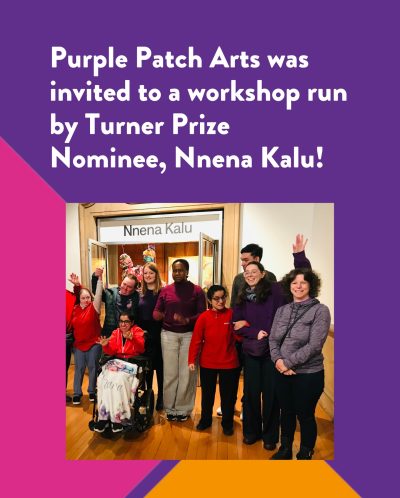 A deeply local connection: Purple Patch Arts and Pyramid
In the run-up to the award announcement, Purple Patch Arts shared their experience of taking part in a workshop led by Kalu herself. Participants had the chance not only to explore her work in the Turner Prize exhibition, but to learn her process directly from her – moving, wrapping, layering and experimenting with the forms that define her sculptures.
Purple Patch were joined by Pyramid, another Leeds-based organisation with a long history of supporting learning-disabled and neurodivergent artists. Their involvement reflects the strong and growing inclusive arts movement across Leeds and West Yorkshire. This is not a distant story: it’s one that connects directly to the work happening here every day to champion accessible, community-led creativity.
See Purple Patch Arts social media post here.
Bradford as the home of the Turner Prize exhibition
This year’s Turner Prize has extra regional significance. As part of Bradford 2025 UK City of Culture, the shortlisted artists’ installations – including Kalu’s celebrated sculptures – are on display at Cartwright Hall Art Gallery until 22 February 2026. It is rare for the Turner Prize exhibition to be hosted outside London, and its presence in West Yorkshire has opened up new opportunities for connection, collaboration and participation.
Kalu accepted the award wearing a handmade rosette reading: “Idol, legend, winner, whatever” – a powerful and playful statement rejecting narrow expectations around what success should look like for artists, especially those who face barriers to traditional visibility.
The Outlook
Kalu’s win sends a message that goes well beyond one prize. It reinforces the importance of:
-
Inclusive arts spaces, like ActionSpace, Purple Patch Arts and Pyramid
-
Accessible routes into cultural participation and recognition
-
Valuing diverse forms of expression, including from artists with limited verbal communication
-
Reconsidering who gets seen, supported and celebrated in contemporary art
For many learning-disabled, neurodivergent and disabled artists – and for the organisations who stand alongside them – this is a moment of real visibility and pride.
Nnena Kalu’s Turner Prize win is a celebration of creative practice, resilience and inclusion. And with its deep links to West Yorkshire’s cultural community, it is also a story that belongs to us.
